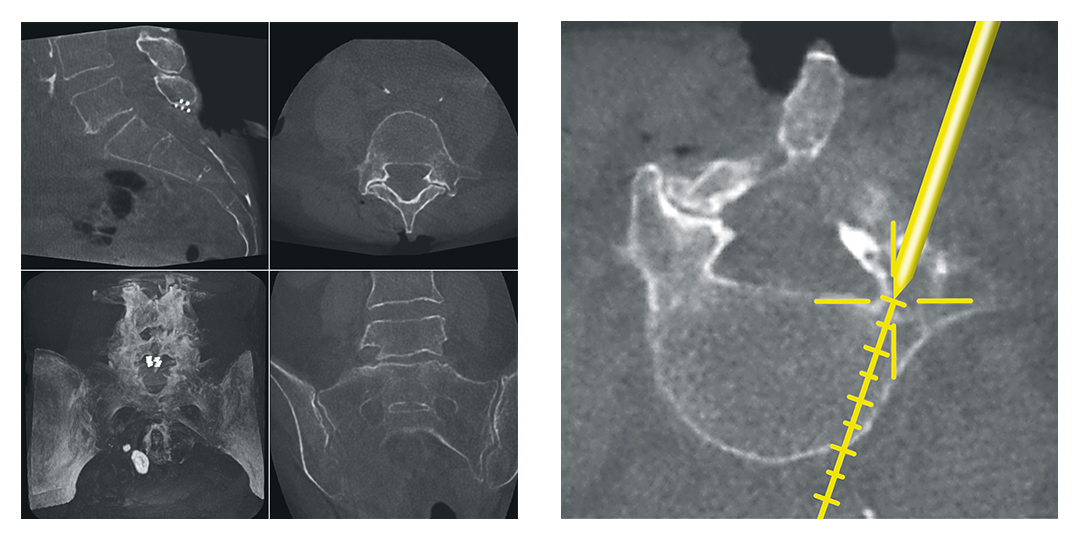
Image-guided surgery
The high-quality intraoperative imaging is the basis for the seamless combination with leading navigation and robotic guidance systems. The proven Ziehm NaviPort 3D interface ensures the safe and automated transfer of high-resolution 3D data, typically removing the need for intraoperative patient registration. The enlarged 3D volume enables navigation of multi-level spinal segments in a single scan – even for patients with a larger habitus – and reduces additional acquisitions.
By combining advanced 3D imaging with image-guided surgical tech- nologies, clinicians can minimize invasive approaches, reduce revision surgeries as well as postoperative CT scans, and gain greater confidence in intraoperative decision-making. Seamless integration, long-term investment security, and continuous improvements help systems to remain prepared for future clinical demands.1,2,3
Navigation and robotic guidance partners

Spine and trauma navigation

Spine navigation, robotic guidance

Spine navigation

Spine navigation

Spine navigation

Spine navigation
Disclaimer
- 1
Recum von, J. et al., Unfallchirurg 2012, 115:196-201, Die intraoperative 3D-C-Bogen-Anwendung. State of the art
- 2
Richter et. al., Cervical pedicle screws: conventional versus computer-assisted placement of cannulated screws. Spine (PhilaPa 1976). 2005 Oct 15;30(20):2280-7
- 3
Gebhard et al., Does computer assisted spine surgery reduce intraoperative radiation doses? Spine (Phi laPa1976). 2006 Aug 1;31(17)
- 4
The availability of the integration may vary by country and depends on Medtronic.